STEVE SCOTT HAS BEEN GUIDING SNOWMOBILERS IN THE MOUNTAINS AROUND REVELSTOKE FOR NEARLY 20 YEARS. Since joining Great Canadian Tours in 2007, he has helped build it into a highly respected snowmobile guiding operation. He is now the Operations Manager and Lead Forecaster, while also volunteering as a manager for Revelstoke Search & Rescue. He is a CAA Avalanche Professional and completed the Level 3 Avalanche Risk Management course. Notably, he is a cofounder and current President of the Canadian Motorized Backcountry Guides Association, and one of its instructors and examiners.
With the advent of the CMBGA, I wanted to talk to someone about the work of a snowmobile guide, especially compared to their more established contemporaries in the skiing world. What does a typical day look like? What do they talk about in their AM and PM meetings? How do they track guests on machines that can disappear with the twist of a throttle? How do they handle the presence of other riders in busy areas?
Steve joined me on a snowy Wednesday afternoon in early- December to answer these questions and more. An abbreviated transcript of our interview follows. For the full version, check out the video below.
Alex Cooper: How did you get into snowmobile guiding and take an interest in the avalanche side of this world?
Steve Scott: The start of my journey would have been growing up on the Calgary side of the Rockies. I had family and friends who were into mountaineering and backcountry skiing, so I was willingly dragged into lots of fortunate experiences in the mountains. It definitely became a passion. Snow science was always something that fascinated me—and how everybody made decisions. I needed to know more about that. Our mid-teenage adventures, we certainly got into some trouble, and it just seemed like a smart decision to learn more about that side of the avalanche world.
I understand you were a ski patroller for a bit. How did you end up as a snowmobile guide?
I had a lot of friends who went straight into the snowmobile world, so I had a community of snowmobilers that taught me. We just fed off each other. They were like, “Steve knows how to get further into the backcountry safe, and we can teach him how to sled.”
When I moved to Revelstoke, there was an opportunity for work at Great Canadian. I had a lot of backcountry experience and enough snowmobile experience. I was actually a horseback guide throughout my 20s, so mixing a little bit of each one of my skills together fit the bill for a sled guide. Then, as a crew at Great Canadian, we kind of self-taught. The Revelstoke community of mentors was phenomenal for pushing ahead my learning in the professional avalanche community.
What was the operation like when you started guiding? What do you remember about when you started and how things were run?
Well, having any kind of formal avalanche training was a little bit new to the industry. There were definitely a lot of people who had no formal avalanche training who were considered snowmobile guides. The community back then—I remember walking into the Boulder Cabin with a group and we all took off our jackets. A few of the old local boys sitting around the fire were like, ”What are them yellow things hanging around your necks?” It was the first time they’d seen a transceiver. In terms of the snowmobile community from the early-2000s to now, it’s phenomenal the growth and cultural shift that’s happened.
What certifications did you have? Did you have Avalanche Operations Level 1?
I came in with that and a history of advanced first aid training. That was more than most people needed to be a snowmobile guide at that point.
Let’s talk about Great Canadian Tours a bit. What kind of tours do you offer?
We run the whole range, starting with a two-hour tour to the cabin all the way up to a full-day tour. Our most popular is a multi-day backcountry tour. They’ll spend three to five days sledding with us, usually with the same guide, going to one of the 10 mountains in our tenure, and have a new experience, get pushed further, and learn new things every day.
How big are the groups you run? What’s your guide-to-guest ratio?
It’s a six-to-one guide-to-guest ratio and typically our average group is four.
Your guests—what kind of experience are they bringing to the table?
A lot of people come with very limited mountain experience but a lot of trail sledding experience. Those are the ones typically drawn towards the backcountry multi-day tours because it’s new to them. It’s intimidating, and they don’t want to just rent a sled and go for it. A lot of people are just visiting Revelstoke, or if they’re heli-skiing and they have a no-fly day, they just want something fun and exciting to do. They’re the ones who jump on our trail tours, which are just exhilarating and get you up there and out no matter the weather.
What kind of avalanche training do you give your guests?
Every guest goes through a very similar training to heli-skiing. It’s like a mini companion rescue course, so they learn how to operate a transceiver, shovel, and probe, how to find a single signal, and then how to work as a team under the guide for an avalanche scenario. But because snowmobile guides are frequently by themselves, we push heavily on them being able to do a single signal transceiver search with probe-and-shovel recovery of the guide just to look after ourselves.
What is your process like in the morning in terms of guides’ meeting, avalanche forecasting? Do you do things like terrain selection or run lists?
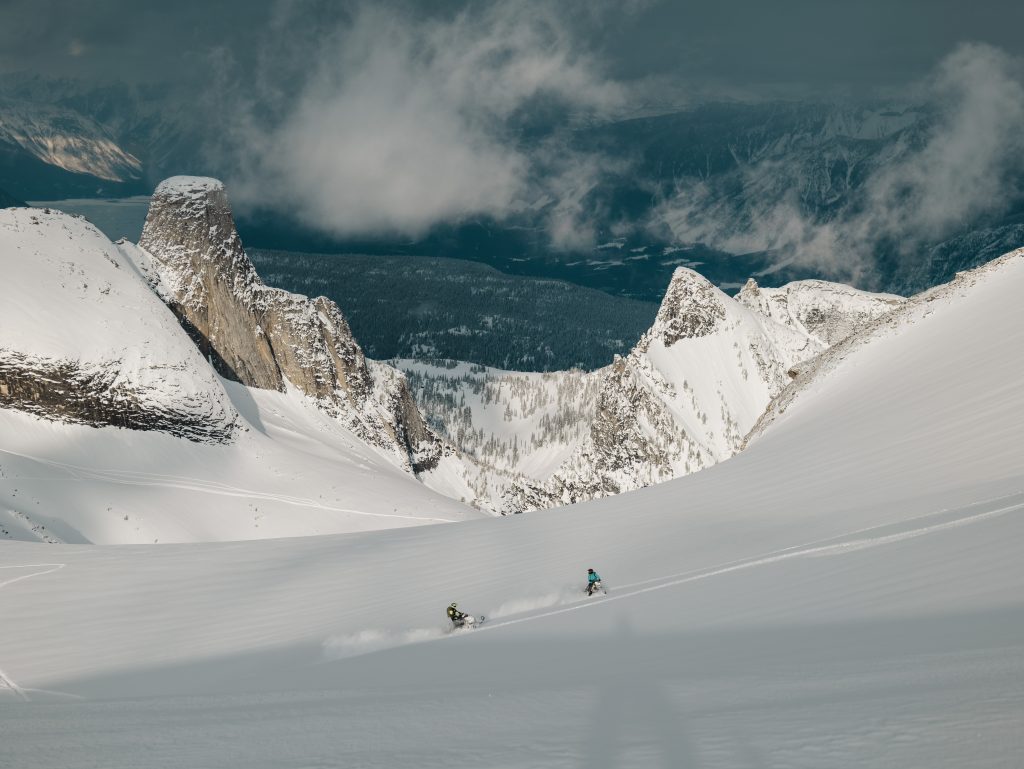
It’s definitely similar to the mechanized guiding operations that I’ve shadowed and been mentored under. Typically, we start a little bit later because on sleds we can sled into the night. Forecasters start at 7 a.m., which is advantageous because a lot of the InfoEx submissions are already done, so we get to read them all.
Our guides’ meeting is from 7:30–8:30 a.m. We analyze conditions, make our input into the InfoEx. I guess the difference for sled guiding is we talk about the different group abilities, the different mountains that would be suitable to the groups, and the route to get there. There are three mountains we can sled to right from our base, but we have seven others we’ll travel to. Traveling is a whole other part, because we travel on FSR’s with a truck and trailer, and then we’ll sled on FSR’s.
There are different avalanche paths there’s possible control issues through, and then there’s the issue of getting back at the end of the day if one of those paths covered the road. There’s a little bit more logistics that way. A full CMBGA guide, they have a lot more freedom from the forecasters. The lower-level guides, we do have a run-list scenario, but I guess it’s more of a bowl list, where most are named riding areas. We have lots of places where we’ll climb chutes, and we have downhill tree riding areas. It would be a polygon designation instead of a run because we go up and down or across these areas.
Sometimes certain guides just do adventure rides. We can ride from Eagle Pass back to our base. You can do a 120-kilometre adventure ride. There’s a lot of different scenarios the forecasters have to prepare for.
If you’re having a high or considerable avalanche danger day, do you set no-go zones? Is that part of your discussions?
Absolutely. Sometimes on a macro scale, we’ll close the entire mountain to all the guides. Turtle, for instance, we frequently close. On a smaller scale, we will close certain bowls that have high overhead hazard that you might not be able to see or manage because of visibility. Or if you’ve got to stay away from a rogue public rider who’s going to start something above you, then we close certain areas that are prone to public rider start zones. When those are closed, no matter the experience of the guide, they’re just not allowed to go in there.
I’m interested in how you handle the presence of other riders. If you’re guiding on Boulder or Frisby, which are hugely popular, I imagine that’s a factor in how you lead people around and approach terrain.
You’re a part-time guide and part-time educator every day on the mountain, so you have to be friendly and try to gently educate some public when they’re doing things that are dangerous around your group. Obviously, we just remove our group from those situations, but usually we try to help and teach the public how to ride around each other safely. We’ll point out if they’re doing something that’s not a good idea or not safe, with no ego or authority. We just help the whole community. Everybody’s usually open to hearing those suggestions, especially when it’s from a guide.
One thing I wonder is a challenge with snowmobile guiding, is the machines are so powerful and it’s not hard for a guest to just hit the throttle and get away from the group. Is that something that happens? How do you manage that?
That is probably the biggest difference in our industry versus every other guiding industry in winter—our guests can go wherever they want at 80 kilometres per hour despite your best efforts to tell them not to. Generally, we’ll set up play-area boundaries that are visually easy to remember. We’ll go to the bottom and set a lowest-elevation line. You can draw these in the snow with your snowmobile, and then you have visual markers for the guests. Sometimes it’s a very large area, but typically our guides are required to have all guests in sight at all times, within reason. All the guests will have radios, which we don’t rely on, but they can be helpful.
When we set up tree-riding areas, which you can’t line-of-sight guide, we draw a pick-up road. We build it with the whole group. You make a road across the bottom of the tree riding area and then a climbing trail to make it easy for people to climb. Then they just do downhill rides using the buddy system and radios. The guide will post themselves up or ride with guests if there’s an odd number of people, or just go around pulling people out the whole time. That’s one of the ways we will use treed downhill riding terrain.
Sometimes you get Swedish guys who just want to climb up, down, across and all through a whole area. We literally can draw boundaries for their snowmobiles and use that.
You can track guests, too. If you have a guest who goes out of your boundary, it will be obvious where they crossed your sled track. Guides at the CMBGA do a huge portion of their training doing tracking. Our company goes through this in our guide training every year.
We have a huge emergency preparedness plan for lost riders. There’s a scenario our dispatch will set up using other guides on the mountain and our staff to do containment. They set up people at certain bottlenecks to the trail or a cabin. Then, while the guide gathers the group and starts to search for the lost guest as a group, the containment can block the rogue guest from going too far. It doesn’t happen often, but it certainly does happen. All the guides in the snowmobile industry are trained heavily on lost-rider procedures.
One thing I’m curious about is your risk tolerance, especially for avalanches. If you trigger a slide, it’s a bit easier to ride out of one on a snowmobile, whereas it might not be possible on skis. Does that factor into your risk management?
From the guide’s perspective, yes. If you have experience with sled-cutting and we’re just pushing snow downhill, you’re pretty good up to a size 1.5 at riding with the snow as long as there isn’t much build up behind you. How we sled cut is different than I would do it on skis just because you do have that extra weight as a tool, you have extra power to dig down in the snow. You also have less vulnerability being on a
snowmobile riding with a size one or 1.5. But when it comes to guests, we don’t ever think, “Oh, they’re less vulnerable.” Because everyone falls off sideways, or they’re facing uphill the wrong direction. You have to be really skilled to set yourself up for success to ride a 1.5.
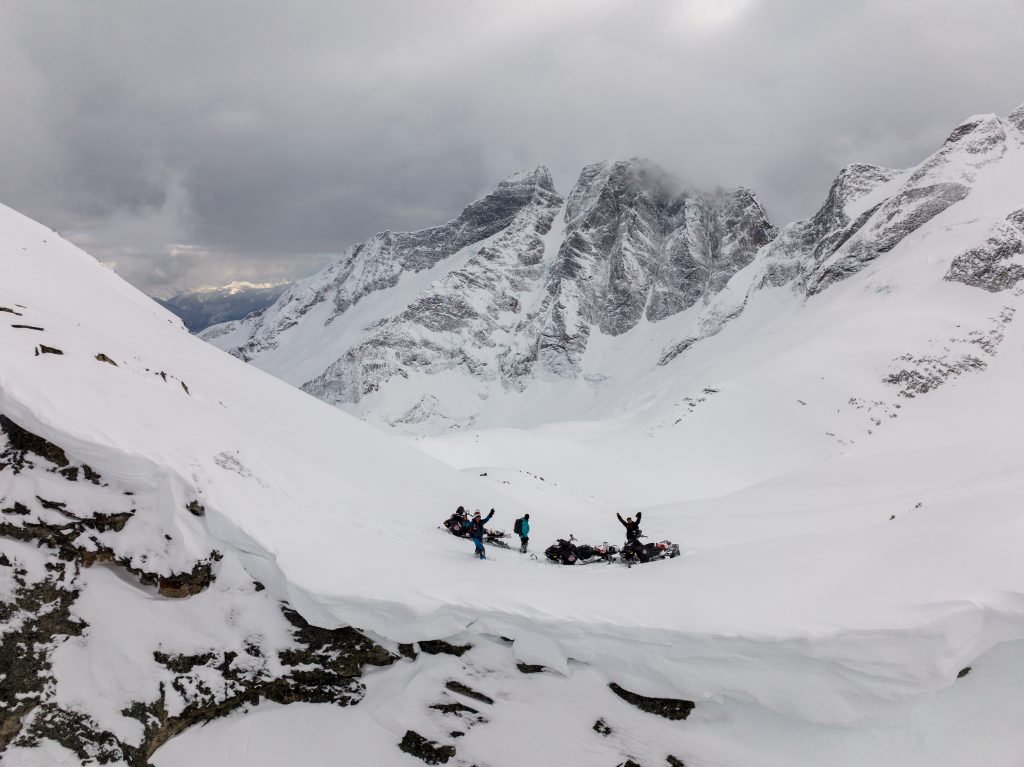
You talked about some mitigation techniques you can use on a sled with slope cutting. I remember once I heard you talk about doing cornice control with a snowmobile. Are there other avalanche mitigation techniques you can do on a snowmobile that a skier wouldn’t have access to?
The sled is a tool that can speed up cutting a cornice. You can trench across the back of the cornice with your sled, and then you can just tie it to a tree, throw the rope over, tie it to your bumper, drive away, and it cuts a little cornice. As a solo person, you can cut a cornice in about seven minutes with just with some sled-based skills that you definitely couldn’t do skiing.
Sleds are a valuable tool for any kind of slope testing because you can use the weight, throw it into the snow, and use the power of the trenching track to really try to tickle layers that would be impossible to do on skis or snowboard. They’re really helpful for slope mitigation or just setting an area up before you let your guests play. You can do a bunch of slope tests and feel very confident you’re not going to have a
surprise.
Are your guides doing kind of standard snow profiles in the field? Is that part of their day?
For sure. Every morning, the forecaster will give each guide a different snowpack objective for holes in our data of the snowpack. Typically not a full profile, unless they’re a junior guide tail-guiding. The junior guides will have to do a full profile every day they’re out tail-guiding. As a lead guide, when you have your own group, we try to make it something they can show their group, or do within 20 minutes. So, targeted, specific layer investigation is usually what we send our guides out with every morning.
Rider compaction is definitely a much bigger thing with snowmobiling if you’re operating somewhere like Boulder, a popular area. Do you factor in compaction when you’re forecasting?
For sure. Right now, there’s places on Boulder that are closed, that will never be closed for the rest of the year, because they haven’t seen compaction yet. There are places that get enough compaction that in 20 years, I’ve never seen them slide, but I saw one of them slide yesterday. Compaction is huge moving into the season.
As a tool, we will frequently send guides out with a big group and we will purposely compact something. We’ll line the whole group up across the top of a hill-climb and one at a time go down the whole hill when we know there’s surface hoar on it. We’ll get rid of that surface hoar using a group when we know a dump’s coming in. Then that hill is still open throughout the storm cycle. There are certain areas we maintain with regular group compaction and modify the snowpack so we can play on it all year.
We talked, we talked about some of the challenges with snowmobile guiding. But there’s got to be some things that are beneficial—the obvious being if it’s high danger, you can just go find a flat area away from overhead hazard to play in. Are there other aspects of snowmobile guiding that you would say are an advantage, or make life easier, than, say, being a heli-ski guide?
I can’t even tell you how many times I’ve been out guiding saying, “Thank God I’m not a heli-guide today.” We don’t have the pressure to use gravity. We can make our own gravity just by hitting the throttle. When it’s high hazard, we just ride flat fun powder. A bumpy field is like a pillow field to a skier just laid flat, and we can just ride it all day. That takes the pressure off guides from feeling like they have to deliver a steep, beautiful pow line when it’s sunny out and it’s high hazard. We just look at it, the ones on the slopes, and play on the flats.
What do you discuss at the afternoon meeting? I guess the obvious are, what were conditions like? What was the weather like? Did you see any avalanches? Are there things more specific to snowmobiling you talk about?
Compaction is a big one. We monitor compaction, especially in some of the less popular snowmobile zones. Then, if we have a play area we’re purposely trying to groom a problem out of, the guide has to give a percentage of how much of that play area was groomed. We monitor each one of those areas for compaction for our future forecasting.
Before my last question, is there anything else you want to say about the day-to-day of snowmobile guiding?
We’re one of the only industries that purposely rides at night. As a guide, there’s a whole different mindset you have to have. Decision-making, risk tolerance—all of that obviously goes down because you have less access to rescue. But comparatively, night riding can be better visibility because with a headlight and a headlamp on your helmet, you have no flat light issues.
We have to prepare for night rescue. We have a pretty elaborate toboggan-towed-behind-a-snowmobile set up that’s really versatile and can get anywhere a skier or a snowmobile could get. Of course, you wouldn’t be able to tow someone out from some of those super intense terrain features, but getting a toboggan with rescue supplies to the person is something we train for and are really good at. We help heli-skiing companies and search and rescue with our resources and ability to do that.
What spurred this interview is the creation of the CMBGA. You’ve been in this industry for over 15 years. What are some of the changes and how have you seen it evolve?
The evolution of a guide certification has changed our industry quite a bit. We’re starting to see a lot more professional recognition from other guide associations now that they’ve seen the whole curriculum and rigorous examination process we have, which is a week-long backcountry exam every year for both the Level 2 and Level 3 guides.
The recognition of snowmobile guides as a professional mountain guide has been really well received. The whole snowmobile guiding community itself has been super keen to up their skills to bring everybody to that upper level. All the different guiding operations in B.C. and Alberta, and a couple in the States now, have seen the value of that. Insurance companies are starting to ask other operations if they have CMBGA certified guides. It’s setting an industry standard which is high and we’re proud of. We’re really happy with the professionalism that has been set for guides in the snowmobile world.
That’s great!
I really appreciate your time. It’s been dumping out there, so I hope you have a great winter.
We will. It’s fun when it starts with some interesting setups like this one. We’ll have our hands full, for sure.